01 — What's next
Your training gave you everything 200 hours can give. Tapastry is for the years after.
You came out of your YTT with the asanas, the philosophy, the cues you'll remember in your bones, everything a 200-hour can instill within you. What you'll build next is its own practice, and you'll build it over years. The classes you teach, the growing portfolio you'll hand to a studio, the disciplined work of becoming a teacher. I built Tapastry for that heat.
Tapastry is a work in progress, just like you and me, and your feedback helps shape it. Feel free to send me a note at any time.
02 — The work after
You know the poses. The business is a different practice.
You can sequence a class, hold space, breathe with the room. What no training prepared you for is the work that begins after the certificate is in your hands.
- The resume and the LinkedIn that don't quite know what to do with a yoga teacher's work.
- How you'll approach your first studio, and what they expect to see.
- The portfolio you'll need, and don't quite know how to make.
- The fifteen classes you'll plan, practice, and teach in your first month, and how by the second month they all start to sound a little alike.
Tapastry is a place for all of it to gather, in the order it actually wants to.
03 — What's inside
What's inside.
Three things, made to work together.
Class Builder
Build your classes the way you actually teach them, by section, by intention, by the rhythm of warm-up and peak and cool-down. Drag poses, write your cueing notes, save the sequences you'll return to. Reuse what works without copy-pasting the same Google Doc twelve times.
Teach Mode
Walk through your sequence before class as a rehearsal, one pose at a time, with timing and cueing in front of you. When you teach online, the same view becomes your streaming companion, full-screen, your webcam overlaid on the page so your students see you and the practice together.
Portfolio
A page you can hand to any studio, gym, resort, or wellness center. Your training, your style, your classes, your story, in one shareable place. The credentials you've earned and the work you've actually done, sitting together where they belong.
Building a class in Tapastry.
04 — What it costs
What it costs.
We tell yoga teachers to charge for their work, and the same has to be true of the tools I make for you. Naming a price is part of how that belief stays honest. If I gave Tapastry away I'd be telling teachers that the work of yoga is the kind of thing that should be free, and I don't believe that.
Limited places
$25 once, for life.
One transaction, no recurring charge, no upsell coming later. One per person. There are 25 of these, and when they're gone, they're gone.
Join the First 25
Everyone else starts with a free two-week trial, no card required. After it ends, introductory pricing is $5 a month or $50 a year. Less than one class.
Some kinds of work only become more important as the world speeds up. I think yours is one of them.
05 — Generosity
Pass it along.
Build a sequence you love and send it to another teacher with a link. They open it on their phone, rendered the way you built it, and they can save it, change it, make it their own. The way teachers already swap sequences in WhatsApp and after workshops, except this version is rendered properly and easier to find again.
Generosity is a teaching practice. Tapastry just makes it easier than copy-pasting notes into a group chat.
06 — Over time
It grows with you.
From day one.
Build classes the way you actually teach them. Save the cueing you keep forgetting. Bookmark the warm-ups that worked. Notice what you teach.
In your first weeks.
Log the classes you taught during training. Add the trainings you've completed and the certificates you've earned. Record a short video of yourself teaching. Your portfolio starts to mean something almost immediately, not at some milestone far off.
After your first few classes.
You can hand a studio a page that means something. Real classes you've actually taught, in front of real students, recorded as you went, alongside the training and credentials you've earned. You don't need a hundred classes for the portfolio to do real work.
07 — From the maker
A note from the maker.
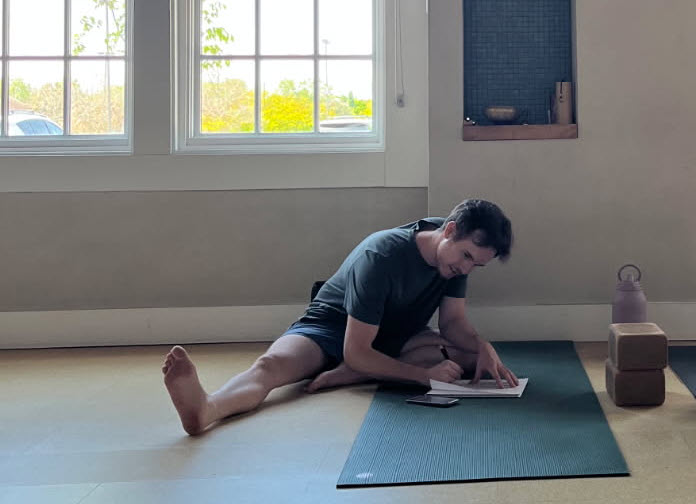
Hi, I'm Tyler. I'm a certified yoga teacher and I made Tapastry for other yoga teachers.
I started my 200-hour thinking it was just for me, that I was doing it for my own practice, and that I would never teach. I left with a desire to pass on what I learned. I left wanting other people to feel what I'd felt during those months. Sitting in a room with strangers who quickly became friends. Talking early and late about the Yamas and the Niyamas, about what the practice was actually asking of us.
I had no idea what I was getting myself into. What I had was a notepad, some books, a list of poses, and a great instructor. What I didn't have was a way to turn any of that into my own teaching life. The tools I'd normally reach for weren't there. That 'one place' couldn't be found. The next steps just weren't anywhere.
I made Tapastry because the gap between "I have a certificate" and "I am a teacher" is real, and nobody had built a place for the months and years in between. I made it because I want teachers to be paid well for the work they do, and to be confident that they can prove that work, plainly, when an employer asks.
I made it for Lizzie Palmer, my teacher at 3B Movement in Provo, whose own practice I am continually in awe of and whose training I will be forever grateful for. And I made it for the five extraordinary women I trained with, who each left their mark on me in ways I can hardly describe, whose strength and honesty and tears will never be forgotten. Thank you Jenny, Alex, Cat, Gwen, and Lindsey.
Teaching has become a vital part of my own practice. If it's becoming a part of yours, I made this for you.
— Tyler
RYT-200 · 3B Movement · Provo, UT
08 — Why the name
Why "Tapastry."
The Sanskrit tapas, the third Niyama, is the disciplined inner heat that transforms. The kind of warmth that doesn't burn what it works on, only raises it.
Pastry. Bread that proofs. Dough that needs the right temperature and the right amount of time and that cannot be hurried. Becoming a teacher is the same kind of slow rise.
Tapestry is the long, woven thing, a teaching life made of threads pulled across years and classes and students and retreats, the slow accumulation of what you know.
Heat
Applied warmth. Tapas. The agent of change.
Discipline
The third Niyama. Steady, repeated, deliberate practice.
Proofing
Transformation that cannot be hurried. Only given time to rise.
09 — Questions
Questions you might have.
Is it ready to use?
Yes. The Class Builder, Teach Mode, and the Portfolio are all live and working today. The pieces inside each will continue to change and evolve as I hear from teachers actually using them. Your account grows with the app.
When can I sign up?
Today. Open Tapastry and create an account. I'd love to hear what you think while I'm shaping the rest.
Is there a free trial?
Yes. Everyone starts with a free two-week trial, no card required, so you can build classes, use Teach Mode, and watch your portfolio fill in before you decide. After the trial it's $5 a month or $50 a year. The First 25 skip the trial entirely with a one-time $25 for life.
Things change quickly, right?
Yes. I'm iterating often. Buttons may move, copy may shift, new things may appear, less-useful things may quietly leave. If you spot something that feels off, or something that would help you teach better, I want to hear it.
What if the price changes later?
The First 25 each pay $25 once and have Tapastry for life, one per person. Introductory pricing for everyone else is $5 a month or $50 a year. I may raise prices for new signups as the app matures, but the rate you sign up at is the rate you stay on.
Can I export my classes?
Yes, that's the plan. The export tooling isn't live yet, but your classes, your portfolio, your sequences are all yours, and exporting them is on the roadmap. Nothing about Tapastry is built to lock you in.
Is my data private?
Yes. Your classes and notes are visible only to you, unless you choose to share them. When you send a sequence link to a friend or to your students, that page becomes visible to whoever has the link, but it isn't findable by anyone else and isn't indexed by search engines. I don't sell data and I don't show ads.
Will you use AI in the app?
Probably yes, where it actually helps. I'm thinking about things like turning a photo of your class notebook into a sequence inside the app, or suggesting sequences based on what other teachers are finding works. The work yoga teachers do is exactly the kind that becomes more valuable as more of the world goes to machines, and I want AI to amplify that work, not replace it. And where work can be done by people, I want people to do it first. Pose photography, illustration, support and feedback responses, those are the places where humans get the first opportunity. I'm not anti-AI. I'm human-first.
Is this for studios?
Not yet. Right now Tapastry is built for individual teachers. I'll think about studio features when teachers start asking for them, not before.
Is this only for new teachers?
No. It's voiced for teachers who are new because that's where I needed it most when I started. But the Class Builder, Teach Mode, and the Portfolio are made to grow with any teacher, however long you've been at it.
10 — The letter
A letter, when there's something real to say.
No schedule. No newsletter cadence. Notes from a working teacher, sent only when there's something worth writing. The kind of email you might actually want to read.
The first one is a longer letter about why I made this.
Or you can open Tapastry directly.